Most welcome sequence templates online were written for high-pressure marketers selling something dubious. They use fake countdown timers, manufactured scarcity, and the kind of copy that makes you feel slightly icky when you reread it. None of that is necessary. Welcome sequences can be warm, honest, and meaningfully more profitable than the screaming version.
This is the structure I've used to write welcome sequences that consistently convert 6–12% of new subscribers into buyers, without ever sounding like a pushy sales page.
Why the welcome sequence is the most important emails you'll ever write
Open rates on the first welcome email are usually 50–80%. Open rates on a normal newsletter, six months later, are 25–35%. The new subscriber is paying attention to you in a way they will never quite be again. That window is precious. Don't waste it.
The job of the welcome sequence is not to "get the sale." It's to deliver three things in order: relief (you're a real human), value (you can actually help me), and momentum (here's what to do next).
The 5-email structure that consistently converts
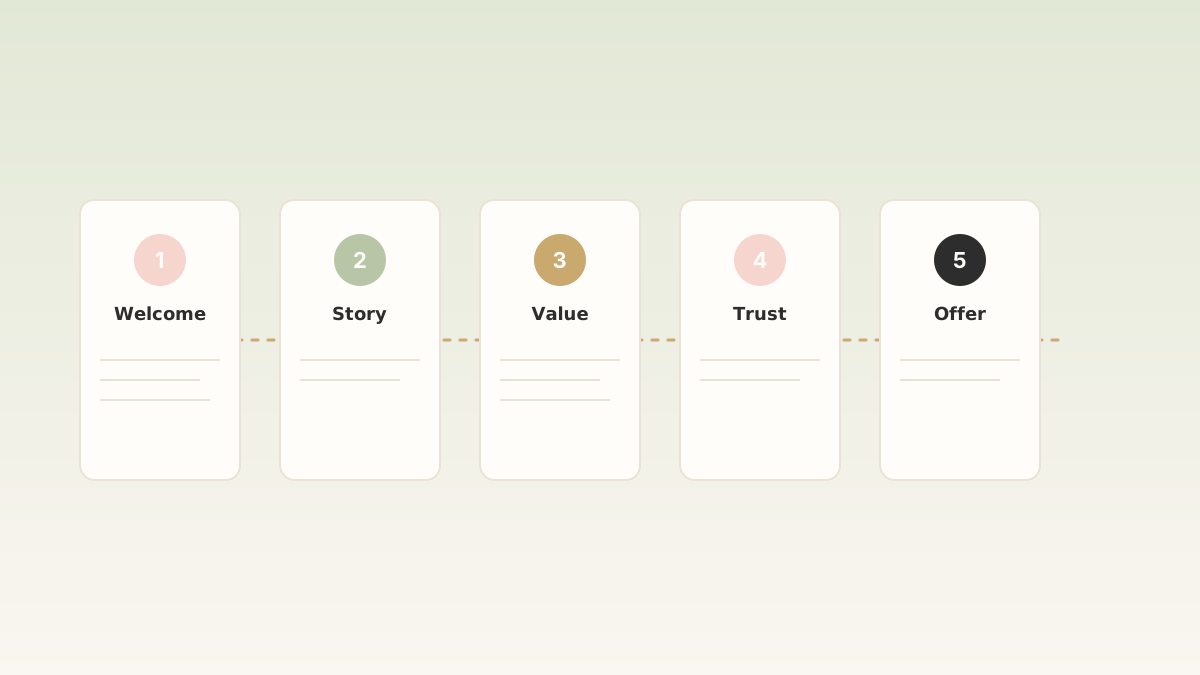
Email 1 — The Welcome (Day 0)
Send immediately after signup. Subject line: "You're in (and here's your guide)". The job: deliver the lead magnet, set expectations for what's coming, and prove you're a real person.
Length: short. 100–150 words. Include the lead magnet link three times (once in the first paragraph, once mid-body, once in the P.S.), so it can't be missed. End with a casual "Hit reply and tell me what brought you here" — replies signal to email providers that your messages should land in primary, not promotions.
Email 2 — The Story (Day 2)
Send 48 hours after Email 1. Subject line: "The honest reason I started this". The job: build trust through a personal story, not a sales pitch.
Length: 250–400 words. Tell the readers in plain language why you do what you do, with one specific origin moment. Vulnerability beats polish here. End with one small CTA — usually to read your most useful blog post.
Email 3 — The Value (Day 4)
Subject line: "My 3 favorite [topic] tips no one talks about". The job: prove you can deliver value with no expectation of return.
Length: 300–500 words. Three short, punchy tips that aren't on your blog. Make these feel like an unfair advantage they got just for subscribing.
Email 4 — The Trust (Day 6)
Subject line: "How [reader name] used this to [result]". The job: social proof through a real story, not a testimonial dump.
Length: 250–400 words. One short case study or reader story. With permission, of course. Connect their result to something the reader could realistically also achieve.
Email 5 — The Offer (Day 8)
Subject line: "If you want to skip the slow path". The job: introduce your most relevant offer — softly, with permission.
Length: 350–550 words. Frame the offer as the natural next step for someone who wants to go faster. Be specific about who it's for and who it's not for. Include a P.S. that addresses the main hesitation. End with one clear call to action and a small note about what's coming next in the regular newsletter.
Save this structure
Pin this post to your "Email Marketing" board. The 5-email arc above is something you can build once and benefit from for years.
The rules that make it not feel sleazy
- No fake urgency. No "expires in 24 hours" if it doesn't actually expire.
- No fake scarcity. No "only 3 spots left" if there are 300.
- One CTA per email. Multiple CTAs reduce action.
- Permission to leave. Each email links to your unsubscribe option without making the reader feel bad about it.
- Real stories with real names (with permission) beat made-up testimonials every time.
Subject line patterns that earn opens (without being clickbait)
- Honest curiosity: "The thing I almost didn't write"
- Specific number: "My 3 favorite tools (and the one I quit)"
- Personal stakes: "What I lost trying this"
- Conversational fragment: "Here's what I'd do differently"
- Contrarian angle: "Why I stopped recommending [popular thing]"
Avoid: ALL CAPS, multiple exclamation marks, emojis at the start (often flagged as promotional), and anything that promises something the email doesn't deliver.
How to set this up technically
Most modern email tools (ConvertKit, Beehiiv, Substack, MailerLite, Klaviyo) support automated welcome sequences. The setup is the same regardless of tool:
- Create a "new subscriber" tag that gets applied automatically when someone joins.
- Build a 5-step automation triggered by that tag.
- Set delays of 0, 2, 4, 6, and 8 days respectively.
- Exclude existing customers from receiving Email 5 (the offer email).
- Send yourself a test of the full sequence using a different email address before publishing.
Metrics that tell you it's working
- Email 1 open rate: 50%+ is healthy. Below 35% means deliverability is hurting you.
- Email 5 click-through to offer: 8%+ is healthy.
- Sequence-to-purchase conversion: 3–8% is realistic for low-to-mid ticket digital products. Higher for soft, warm offers.
Frequently asked questions
Is a 5-email sequence too long?
It's about right. 3 emails feels rushed; 8+ feels overwhelming. 5 is the sweet spot for a small-to-mid offer.
What if I don't have an offer to sell yet?
Skip Email 5 or replace it with a free deeper guide. The first four emails alone build relationships that pay dividends when you do launch something.
Should I personalize with first names?
Sparingly. One use per email, ideally not in the subject line — overuse signals automation and reduces open rates over time.