
Affiliate marketing has a reputation problem. The loudest version online involves screenshots of $40K days, blurry "system" funnels, and overstuffed product reviews that read like hostage notes. That’s not what we’re doing here.
This is a slower, kinder roadmap to your first $1,000 — the kind that builds a real reader base, picks honest offers, and creates a foundation you’d be proud to put your name on. The kind that compounds for years instead of fizzling in two months.
Let’s walk through it together.
What affiliate marketing actually is (and isn’t)
Affiliate marketing is when a brand pays you a commission for sending a paying customer their way. You share a tracked link, someone clicks, they buy, you earn a percentage. Simple in theory.
The version that fails is the one where you carpet-bomb the internet with links to whatever pays the most. The version that works is when a real reader trusts your taste, asks "what would you recommend?", and you happen to have a thoughtful answer that earns you a small commission.
The best affiliate income looks suspiciously like good advice followed by a tiny financial thank-you.
The first decision: who you’re writing for
Before you join a single affiliate program, name your reader. Not a "target persona." A real, specific human you’d be glad to spend an afternoon with.
Mine looks like this: a woman in her early 30s who works in marketing, dreams about building a small online business on the side, and is overwhelmed by tool reviews. She wants someone she trusts to say, "use this, skip that, here’s why."
If you can write that paragraph for your imaginary reader, the next 90% of your decisions are easy.
Picking your niche (without overthinking it)
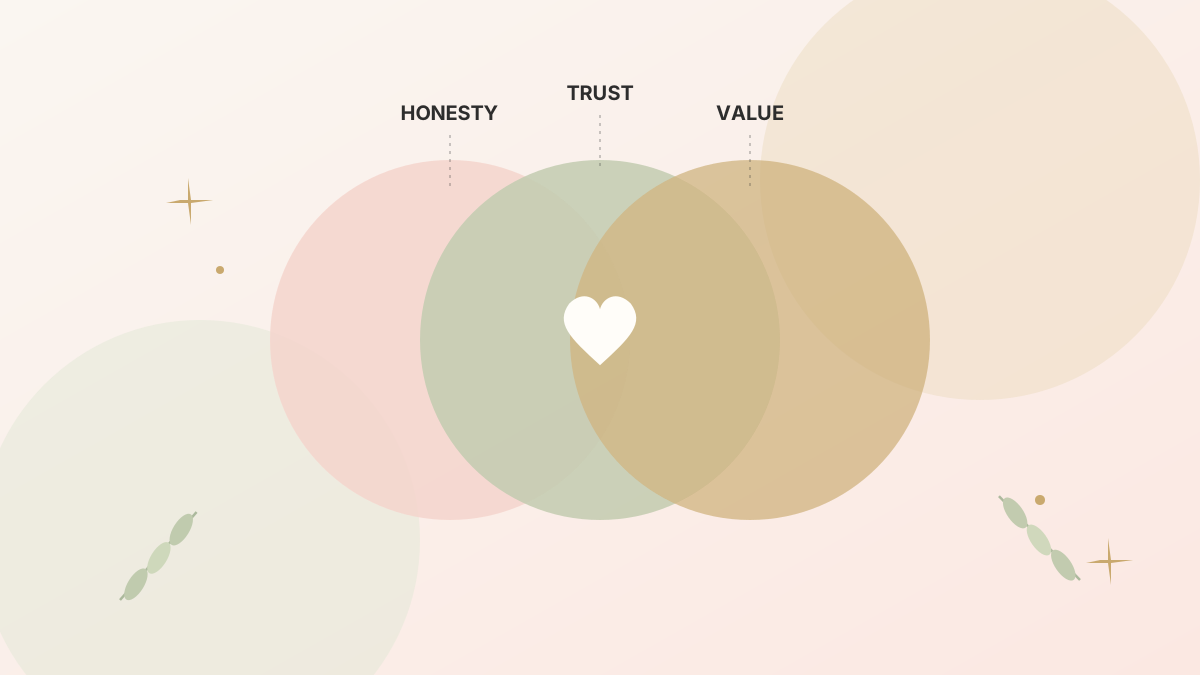
The strongest affiliate niches sit at the intersection of three things:
- Things you have actual experience with — even amateur experience counts.
- Things people actively search for solutions about — not just admire passively.
- Things that have meaningful affiliate programs attached — usually digital tools, education, or services pay best.
"Beautiful candles" can be a real niche, but the affiliate programs are tiny. "Email marketing tools for solo creators" is a smaller-feeling niche but pays $200–$400 per referral on annual plans. Niche hard, then go deep.
How to actually pick affiliate programs to join
Three questions, in order:
- Would I recommend this product if there was no commission at all? If the answer isn’t a clean yes, walk away.
- Is the cookie window at least 30 days? Shorter than that and you’re fighting tracking decay.
- Is the commission structure sustainable for me? Recurring commissions on subscription products beat one-time payouts on physical goods 9 times out of 10.
Common starting points for our niche: ShareASale, Impact, Amazon Associates (low commission but high trust), individual SaaS partner programs (often the highest paying), Awin, Rakuten Advertising, and the official affiliate programs of any tool you genuinely use daily.
Position right before the practical "how to" section, where readers are most engaged.
The 3 content formats that drive 90% of affiliate income
You don’t need to publish every type of post. In fact, picking just three formats and doing them well is the entire game.
1. The honest comparison post
"X vs. Y vs. Z for [specific use case]." Real test, real numbers, real opinions. These rank well, convert well, and build trust because they include the option you didn’t pick. They take longer to write, but a single great comparison can earn for years.
2. The how-I-actually-use-it tutorial
Less "this product has features," more "here’s the exact way I solved a problem with it." Specificity is the persuasion. A reader nodding "yes, that’s my problem too" is worth a thousand listicle-style mentions.
3. The honest roundup
"7 [tools/products/courses] for [specific kind of person] in 2026." These rank well for high-intent keywords. The trick is being willing to say "skip this one" about products you don’t love. Counterintuitively, that grows revenue, because trust converts.
Building the smallest audience that pays
You do not need a huge audience for $1,000. I made my first $1,000 in affiliate income with a blog that had 3,400 monthly visitors and an email list of 480 readers. The math works at small scale because high-intent traffic converts.
Three traffic strategies that work for beginners — pick one or two, master them:
- SEO blog posts targeting low-competition, buying-intent keywords ("best [tool] for [specific niche]"). Slow start, beautiful compound growth.
- Pinterest pins linking to your blog comparison posts. Especially effective for finance, lifestyle, and business niches.
- A weekly newsletter where every fourth or fifth issue includes a single, soft affiliate recommendation tied to that week’s topic.
The math of your first $1,000
Let’s make this concrete with a realistic example. Imagine you join the affiliate program for an email marketing tool that pays $30/month recurring per active referral, capped at 12 months ($360 lifetime value per referral).
- Three referrals per month × $30 × 12 months = $1,080 in eventual commissions.
- That’s about one referral every 10 days from a small, engaged audience.
If your blog comparison post converts at 2% (a conservative number for high-intent search traffic), you need roughly 150 readers a month from that single piece to hit your goal. That is a small, achievable amount of search traffic.
The legal and ethical bits — please don’t skip this
Affiliate disclosure isn’t just polite — in most jurisdictions, it’s legally required. In the U.S., the FTC expects clear disclosure near every affiliate link, not buried at the bottom. The EU and U.K. have their own equivalents.
What clear disclosure looks like:
- A visible note at the top of any post containing affiliate links.
- A standing disclosure on your disclaimer page linked in the footer.
- Small text near the link itself for long posts.
This article should not be your only source of legal information. Talk to a lawyer or a regulator’s plain-language guide for your country if you have any doubt.
Save this part
The single most valuable habit a new affiliate marketer can build is disclosing clearly and only recommending products they’d use without commission. Everything else compounds from there.
The 90-day plan to your first $1,000
If you want a structured runway, here’s the version I’d follow if I were starting over today:
Days 1–14: Foundations
- Pick one niche and write the imaginary-reader paragraph.
- Choose three affiliate programs to focus on (one anchor, two complements).
- Set up a simple blog or newsletter — Ghost, Beehiiv, or WordPress are all fine.
- Write your disclaimer and disclosure pages.
Days 15–45: First 4 cornerstone posts
- One honest comparison post.
- One how-I-actually-use-it tutorial.
- One roundup with at least 5 alternatives.
- One personal story-led essay that links to all of the above.
Days 46–90: Distribution & iteration
- Make 5 Pinterest pins per cornerstone post (25 total).
- Send a weekly newsletter — every 4th issue can softly mention one recommendation.
- Track which links actually earn. Double down. Drop everything else.
By day 90, most readers who follow this plan won’t have hit $1,000 yet — and that’s fine. What you’ll have is the engine. Income arrives a few months behind effort. The compounding is real.
The 90-Day Affiliate Marketing Tracker (Free)
A printable Notion template with the exact 90-day plan above, including weekly check-ins and a content calendar.
Get the tracker →Free download. We’ll add you to the Sunday Bloom newsletter — unsubscribe anytime.
What to do when you hit a wall
Most beginners hit a low-energy patch around week six, when the math hasn’t materialized yet but the work is real. The honest truth: this is the moment 90% of affiliate marketers quit, which is exactly why the 10% who keep going do so well.
What helps:
- Re-read your imaginary-reader paragraph. Adjust it. They’ve probably evolved.
- Audit your top three posts. Are they helpful first, sales second?
- Send a real email to a real reader. Ask what they wish you’d cover. One real reply is worth twenty hours of guessing.
Frequently asked questions
How much money do I need to start affiliate marketing?
Realistically, $0–$200 to start. A domain ($12), a basic blog or newsletter platform (free–$20/month), and an email tool. Skip courses for now; the free internet is full of better information than 90% of paid programs.
How long until I see my first commission?
For SEO-led affiliate blogs, expect 3–6 months to your first commission. Pinterest can be faster (sometimes within 30–60 days). Newsletters are fastest if you already have a small list — sometimes within a week.
Can I do affiliate marketing without a blog?
Yes. Newsletters, YouTube, podcasts, and Pinterest accounts can all drive affiliate income. A blog tends to compound best long-term because of search, but it isn’t mandatory.
Do I need an LLC or business entity?
Not to start, in most countries. Many affiliates begin as sole proprietors and form an LLC or its equivalent once they’re consistently earning income. Talk to a tax professional in your jurisdiction; this article is not tax advice.