Last year I had a wonderful virtual assistant named Priya. She handled my inbox, scheduled my client calls, formatted my social posts, and chased late invoices. She cost me $1,400/month, and she was worth every dollar. Then she moved into a full-time strategy role at a different company, and I had to figure out what to do.
I decided to try replacing her — not out of cheapness, but as an experiment. Six months in, here's the honest report on what AI handled well, what it handled badly, and the one job I quietly gave back to a human.
Setting up the experiment
I made a list of every recurring task Priya used to do — 22 tasks total — and ranked them by how much time they took per week and how creative or relational they were. The hypothesis: AI could probably handle the repetitive, format-heavy work, but anything requiring judgment, context, or warmth would suffer.
I gave myself one rule: any task where AI produced a noticeable quality drop for two weeks in a row would be returned to a human, no shame.
What AI handled brilliantly
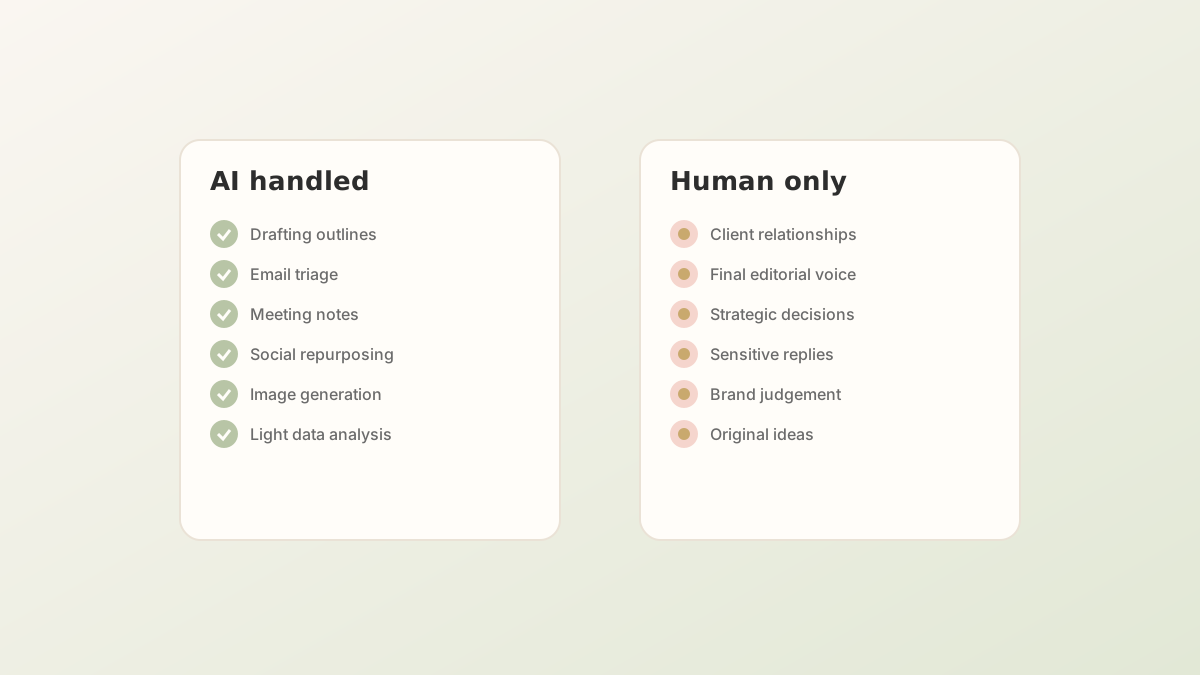
1. Inbox triage
I now use a combination of an AI email assistant and a smart filter that classifies incoming messages into "respond yourself," "draft reply available," and "auto-archive." Net time savings: about 3 hours a week. Quality is honestly better than when Priya did it, because the AI doesn't get tired around message #80.
2. First-draft writing
Blog post outlines, sales page first passes, newsletter drafts, social captions — all of these used to be partial human work. Now I prompt a chat assistant with my notes and outline, and it returns a workable first draft in 90 seconds. I still edit heavily. The total time per blog post dropped from 6 hours to 2.5.
3. Meeting transcription and summary
An AI meeting recorder sits in every call, transcribes, and produces an action-item summary by the time I close my laptop. I used to spend 30 minutes after each call writing this up. That's 4–5 hours saved per week.
4. Repurposing one piece of content into many
Long blog post → six LinkedIn posts, three Twitter threads, an email summary. Used to be Priya's Friday afternoon. Now it's 20 minutes with a careful prompt and human editing.
5. Image generation for blog and social
Custom illustrations and pin variations are now done in-house with AI image tools instead of hiring a freelancer. With a consistent style sheet, the output quality holds up.
6. Light data work
I send AI a CSV export, ask for a summary or a chart, and get a useful answer in minutes. This used to take Priya half a day with spreadsheets.
What AI handled badly
Anything emotionally complex
Refund requests with frustrated customers. Sponsorship negotiations with pushy reps. Replying to a long-time reader sharing personal news. AI gets the *form* of empathy right but misses the texture. Every time I tried to delegate this to AI, the response felt slightly cold, slightly off, slightly templated. People notice.
Strategic prioritization
"Which of these three projects should I focus on this quarter?" I asked AI versions of this question dozens of times. The answers were always plausible and always shallow. The real answer comes from someone who knows the *texture* of your business — your historical wins, your aversion to certain client types, the way you get bored on month four. AI doesn't know that yet.
Brand-voice consistency at scale
For one or two posts, AI sounds like me. For twenty, the voice slowly drifts toward generic warmth. Without rigorous editing, my newsletter started losing the small quirks that made readers reply.
The one task I had to bring back to a human
Customer support replies for paid products.
I tried for two months to let an AI assistant handle the front line of refund requests, technical issues, and "is this right for me?" pre-purchase questions. The AI was technically accurate. But my refund rate rose 40% in those two months, and a few customers wrote back saying things like "I felt like I was talking to a help desk." Not the brand I want.
I now pay a part-time human (10 hours a week, $24/hr) to handle the first response to every paid-product email. AI drafts the suggested reply; the human edits and sends. Refund rate dropped back to baseline within a month.
The honest takeaway
AI replaces tasks beautifully. It does not replace relationships — yet. The smart move isn't full replacement; it's giving humans the work that requires humanness, and giving AI everything else.
The financial scoreboard
- Old VA cost: $1,400/month
- New AI tool stack: ~$160/month
- Part-time human for support: ~$960/month
- Net savings: ~$280/month, plus better turnaround on most tasks.
Not as dramatic as the "AI replaced my entire team" headlines. But the work is faster, the quality is similar to better, and I have back the $1,400 a month minus a manageable support investment.
The setup I'd recommend
If you're considering replacing or supplementing a VA with AI, here's the lean stack I'd start with:
- One frontier-grade chat assistant for general thinking, drafting, and judgement-light tasks.
- One AI meeting recorder/summarizer.
- One automation tool (Zapier or Make) wired with AI steps for inbox triage and lead routing.
- One human, even part-time, for anything customer-facing or relational.
Frequently asked questions
Should I cancel my VA right now?
Probably not. Better: have a conversation about which of their tasks could be partially or fully AI-assisted, and free them to do higher-value strategic work. Most VAs are more than capable of growing into that role.
Is this ethical? AI is replacing jobs.
It's a real concern and worth sitting with. My honest answer: I freed up budget that I redirected toward a higher-paid, more strategic part-time human role. AI freeing humans from repetitive work is not automatically bad — but the redistribution of that time and money matters. Be intentional.
What's the biggest mistake to avoid?
Letting AI handle anything customer-facing without a human review layer. The cost of one bad reply at scale is far higher than the time saved.